(apparently) These are a few of my favorite things because I've been missing them the most:
1. Chipotle. Don't judge me. Last night I dreamed I left Rome early so that I could go home to Chipotle (but I was nervous because Rachel's package hadn't arrived yet and I didn't know if I should stay and wait for it or if they'd be able to ship it to me in America, even though it had just come from America, or what..).
2. Sookie. I know this is an obvious one. And I know you're not judging me for it.
3. A living room atmosphere. This means comfortable couches or chairs filled with familiar friends or family set up on a rug, in a real room, in an arrangement around a working television that encourages social interaction.
4. Driving (or passenger-ing, I really don't care) with the windows down and the music up.
5. The confidence that if I start talking to someone on the street they will understand what I'm saying to them.
If I think of anything else I'll let you know.

Tuesday, November 8, 2011

Sunday, November 6, 2011
The Four Major Basilicas of Rome
I have now officially been to all four major basilicas. These four churches, all located in Rome, are considered "major basilicas" because they have a holy door [porta santa, which is sealed shut from the inside except during holy years, or Jubilees. Jubilees occur every 25 years and date at least back to the 1400s; the last was in 2000. Usually the Pope has to knock down the doors (which have been previously loosened of course), but Pope John Paul II changed it so that he only had to push the doors open (because they fell on Pope Paul VI the time before)], because they are the main destinations during the Jubilee (as appointed by Popes), and because only the Pope or people he appoints may celebrate mass here.
They're located at these blue dots:
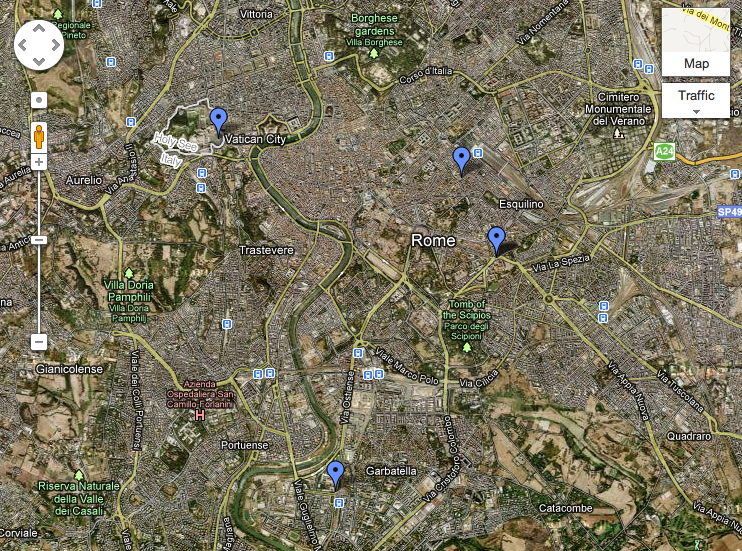
Going clockwise, they are Basilica Papale di San Pietro in Vaticano (the Papal Basilica of St. Peter in the Vatican), Basilica Papale di Santa Maria Maggiore (the Papal Basilica of St. Mary Major), Arcibasilica di San Giovanne in Laterano (the Papal Archbasilica of St. John Lateran), and Basilica Papale di San Paolo Fuori le Mura (the Papal Basilica of St. Paul Outside the Walls).
First, St. Peter's.


St. Peter's has the largest interior of any Christian church (it covers 5.7 acres). It's important because Saint Peter was named the first Pope when Jesus handed him the keys to heaven. This basilica is built over the tomb of Saint Peter. It is built over Old St. Peter's in 1505 (or at least that's when Pope Julius II actually decided to demolish the old basilica. The building wasn't finished for the next 120 years). Bramante, Raphael, and Michelangelo all drew plans for the new basilica, but the majority of the final design is usually attributed to Michelangelo. Inside is an altar by Bernini (kind of seen in the lower picture), the Pietá by Michelangelo, and contributions by Bramante.
I live about a fifteen minute walk from Piazza San Pietro. If you get close enough, you can hear the church bells ringing on the hours. It's a giant square that includes post offices, shops, the steps with the Swiss guards, fountains, an obelisk, and the facade of St. Peter's. Right outside are numerous restaurants and tourist shops. It's an awesome place to be able to walk to regularly or ride by on the bus on a daily basis.
Next, St. Mary Major.

St. Mary's, located a few metro stops across the river from where I live, is the largest Catholic church dedicated to Mary in Rome. It's also called Our Lady of the Snow because of a legend that snow fell in the middle of the summer on the place that a temple should be built for Mary. It is also the burial site of St. Jerome, who created the Vulgate, the first Latin translation of the Bible.
The church was built by Pope Sixtus III in the 400s right after a council that proclaimed that Mary was the mother of God. It's been expanded and partially rebuilt since then, however, especially after the earthquake in 1348.
 Before the papal residence was moved to the Papal Palace in Vatican City, it was temporarily in a Papal Palace at St. Mary's.
This basilica has the highest bell tower in Rome, which you can see in the photo. Inside, the elaborate ceilings are decorated with Inca gold. The apse and nave are completely made of mosaic, which contains some of the earliest depictions of Mary, dating back to the 5th century. The nave mosaics mostly contain images of Moses.
To the right you can see the porta santa, which is always available from the outside, but is bricked off from the inside.
Third, St. John's.
 Saint John Lateran is the oldest (consecrated in 324) and highest ranking of the four major basilicas because it is the official seat of the Bishop of Rome, the Pope (which is why it is an arch-basilica), as well as the ecumenical mother church of the whole world for Catholics. As with St. Mary Major, it is part of the Holy See, which is kind of like an extension of Vatican City.
The basilica has been rededicated to Saint John the Baptist and later Saint John the Evangelist, who are now both co-patrons of the church, although it is understood that it is mainly dedicated to Jesus.
 The facade was rebuilt in 1735 by Alessandro Galilei, looks like a palace, and was modeled after Michelangelo's palace on the Capitoline Hill, with colossal order columns creating an oversized entryway.
Across the street from the church is an apse that is still standing, even though the rest of its original building is not. Like St. Mary's and the apse inside St. John's, this apse is made entirely of mosaic, and depicts the handing of the keys.
Inside the church is the Papal Throne as well as several Popes' tombs.
Last, St. Paul's Outside the Walls


It has to be specified that this is St. Paul's Basilica Outside the Walls (of Rome) because there is another, lesser, St. Paul's inside the walls of Rome.
This basilica was founded by the Emperor Constantine in the 4th century, and is built over the burial site of Saint Paul (relatively recently, they did testing on a tomb found beneath the church and found that the body dated back to the 1st or 2nd century). Other emperors worked to improve it, and by the 5th century it was monumental because it was larger than Old St. Peter's Basilica at the time, and is still the second largest of the four great basilicas in Rome.
It has been rebuilt after the earthquake in 1348 and a fire in 1823, and was reopened in the 1800s. During the second rebuilding, all different countries contributed--Egypt sent alabaster, Russia sent lapis lazuli.
This basilica is unique, surrounded by a large colonnade and eclectic, with pieces from all different countries and time periods. The interior is unique because of the simple rectangular layout with no chairs or decorations, which gives it a very open and clean feel. It contains ancient mosaics, a Medieval tabernacle, and even some 20th century additions.
It's interesting to note the similarities and differences between the four basilicas. St. John's, St. Mary's, and St. Peter's all have similar facades with statues across the top. St. John's and St. Paul's both have statues of all the disciples along the walls. St. Peter's and St. Paul's have similar uses of ornamental gold in the ceilings and mosaics. However, they also all have their unique meanings and stories which makes them each fascinating and beautiful.
Thursday, November 3, 2011
Sometimes Italians Listen to Their Own Music!
I have some excellent Italian music videos for you:
Nel Blu Di Pinto Di Blu (Volare)
"In the blue painted blue,
Happy to be up there"
by Domenico Modugno
24000 Baci
"24000 Kisses"
by Adriano Celentano
"Insieme a Te Non Ci Sto Piú"
"With you there is more"
by Caterina Caselli
"Bella"
"Like a beautiful morning
Crystal clear water
Like a window that illuminates the pillow.."
by Jovanotti
Sunday, October 30, 2011
Italians use strollers for children up to the age of about seven.
Today I stumbled upon the Ikea, where I ate meatballs and mashed potatoes and cheesecake (a regular Thanksgiving meal), and bought space slippers which are pretty awesome.
Then I walked past a little park where everyone was locked inside (?) and dancing (but not like professionally..just circles of people casually dancing to music). And everyone else was sitting outside eating peanuts and drinking beers watching them. I hope you're confused because I was too. I spend a lot of time here being confused as to what's going on. But that makes it fun, right?
Then I walked past a little park where everyone was locked inside (?) and dancing (but not like professionally..just circles of people casually dancing to music). And everyone else was sitting outside eating peanuts and drinking beers watching them. I hope you're confused because I was too. I spend a lot of time here being confused as to what's going on. But that makes it fun, right?
Friday, October 28, 2011
Introduction to Italian Driving
There must be some rules Italian drivers follow, but they're certainly not the same as American driving rules. Another difference is that driving rules are enforced in America. It seems that in Germany, the rules aren't enforced because Germans like to obey. In Italy, rules aren't enforced because the responsibility is left to the individual, and it seems to work okay for them.
For the rest of us, it's terrifying. Here are a few rules I've picked up on through real-life observation.
For vespa drivers:
If the street is too crowded, you have a few options. You can weave in and out of cars, stopping dangerously close to the sides of busses and humans. You can ignore lights and other driving signs in order to pass everyone you can, especially if your small child is seated on the back and you're eating a panino. You can travel in packs that terrorize the streets. Or, if the streets are just too crowded, you can certainly drive on the sidewalk. Just honk at the pedestrians until they move.
For bus drivers:
Busses can fit through car-sized spaces, so don't be afraid to squeeze in between cars. You don't always have to stop at stops, and you may arrive according to whatever schedule you want to follow (or no schedule at all). You can mess with riders by opening all doors except the one they're standing at, or by shutting doors on their feet. Slamming on your breaks suddenly is usually a crowd pleaser. Also, feel free to stop for smoke breaks at random intervals and stop only inches away from the cars in front of you.
For car drivers:
As long as no cars are coming from the opposite direction, any lane is free game to drive in. If no lanes are available, feel free to create an additional lane in between cars. If pedestrians are crossing, you can still drive even when your light is red. You should probably honk all the time. The Italians have perfected the "friendly honk" (a beep beep for: "hey, you're in my way," "your car's still sticking into my lane a little bit," "I see you're about to back into me, please don't," "will you wait right there for a second so I can pass you?") but they've also perfected the rude honk. And the honking for no apparent reason at all.
When parking:
Even though your car is the smallest car on the market, you can take up a giant space if you want. You can park in the middle of the street (literally the middle. Don't worry, just leave it there over night. It's okay.) You can double park whenever you'd like. You can park the opposite direction on a one-way street, or drive the wrong way on a one-way in order to back up into a parking spot.
For pedestrians:
Consider that you are never safe. If you're on the sidewalk, you could still get hit. If you're crossing when you have a green light, you could still get run over. If you're just walking and minding your own business you'll probably still get honked at. If you're sitting eating at a restaurant, you might have to pick your table up off the street for a minute so that cars can pass. The metro might be the safest route for you.
For the rest of us, it's terrifying. Here are a few rules I've picked up on through real-life observation.
For vespa drivers:
If the street is too crowded, you have a few options. You can weave in and out of cars, stopping dangerously close to the sides of busses and humans. You can ignore lights and other driving signs in order to pass everyone you can, especially if your small child is seated on the back and you're eating a panino. You can travel in packs that terrorize the streets. Or, if the streets are just too crowded, you can certainly drive on the sidewalk. Just honk at the pedestrians until they move.
For bus drivers:
Busses can fit through car-sized spaces, so don't be afraid to squeeze in between cars. You don't always have to stop at stops, and you may arrive according to whatever schedule you want to follow (or no schedule at all). You can mess with riders by opening all doors except the one they're standing at, or by shutting doors on their feet. Slamming on your breaks suddenly is usually a crowd pleaser. Also, feel free to stop for smoke breaks at random intervals and stop only inches away from the cars in front of you.
For car drivers:
As long as no cars are coming from the opposite direction, any lane is free game to drive in. If no lanes are available, feel free to create an additional lane in between cars. If pedestrians are crossing, you can still drive even when your light is red. You should probably honk all the time. The Italians have perfected the "friendly honk" (a beep beep for: "hey, you're in my way," "your car's still sticking into my lane a little bit," "I see you're about to back into me, please don't," "will you wait right there for a second so I can pass you?") but they've also perfected the rude honk. And the honking for no apparent reason at all.
When parking:
Even though your car is the smallest car on the market, you can take up a giant space if you want. You can park in the middle of the street (literally the middle. Don't worry, just leave it there over night. It's okay.) You can double park whenever you'd like. You can park the opposite direction on a one-way street, or drive the wrong way on a one-way in order to back up into a parking spot.
For pedestrians:
Consider that you are never safe. If you're on the sidewalk, you could still get hit. If you're crossing when you have a green light, you could still get run over. If you're just walking and minding your own business you'll probably still get honked at. If you're sitting eating at a restaurant, you might have to pick your table up off the street for a minute so that cars can pass. The metro might be the safest route for you.
Thursday, October 27, 2011
Weekend Trip #3: Barcelona
 |
Caitlin's friend from home (Izzy) is studying in Barcelona, so she was our tour guide most of the time, which was convenient because we didn't have to plan everything out on our own and we didn't get lost at all.
I was surprised at how different Barcelona feels than Rome. Overall, the city is much more with it than Rome. The typically stubborn Romans are happy in their old habits and don't feel the need to modernize themselves or their city. Barcelona has more convenient stores (instead of separate stores--tabacchi shops, farmacias, bancomats, small grocery stores) with more "American" brands like Lays, Pringles, Orbit and Trident gum (I stocked up on normal gum before I left). They have multiple subway lines, which makes it much easier to get around. Of course the architecture is much more modern, which means that stores have larger floor plans and it's not as cramped.
The people were also very polite. They weren't overly friendly like in Palermo, just more polite. They certainly waited for everyone to get off the subway before they got on, which is much different than the Roman battle to make it inside, or out of, the metro car. They also have a sense of personal space, and will actually walk around you instead of into you, or give you a little room to breathe on the subway.
The streets were much cleaner than Rome's, even though you can see street cleaners all the time here. The women dressed much more fashionably than in Rome. There was a certain energy that carried over into the nightlife that was way more upbeat and seemed to attract a younger crowd. Lot of bars served popcorn, and I liked that. We drank lots of Sangria, and went to a "shots bar," which had a wall filled with the names of shots, but not their ingredients. Basically, you were blindly ordering drinks based on their names. Lots were served on fire. There were also nice clubs and bars all along the beach that were packed every night. It was a much more glamorous nightlife than in Rome!
 |
| The fancy popsicles! |
Here are some of the sights we saw:
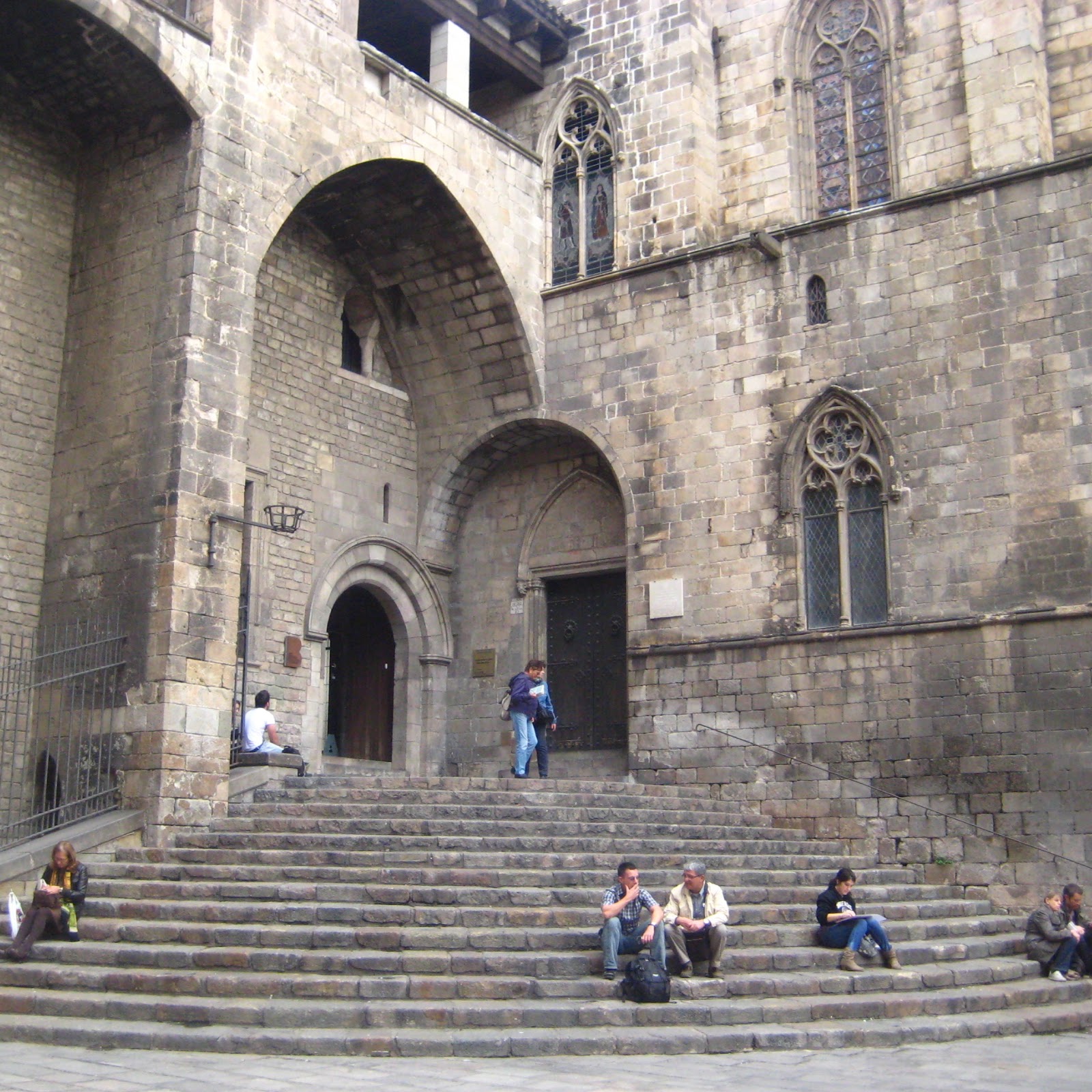 |
| The square where they apparently welcomed Christopher Columbus back from discovering America (questionable). |
 |
| The carrer del Bisbe, the Bishop's street, a famous skywalk linking the President's house to the Catalan Government seat in the Gothic district. |
 |
| La Seu Cathedral, also in the Gothic district of the city. |
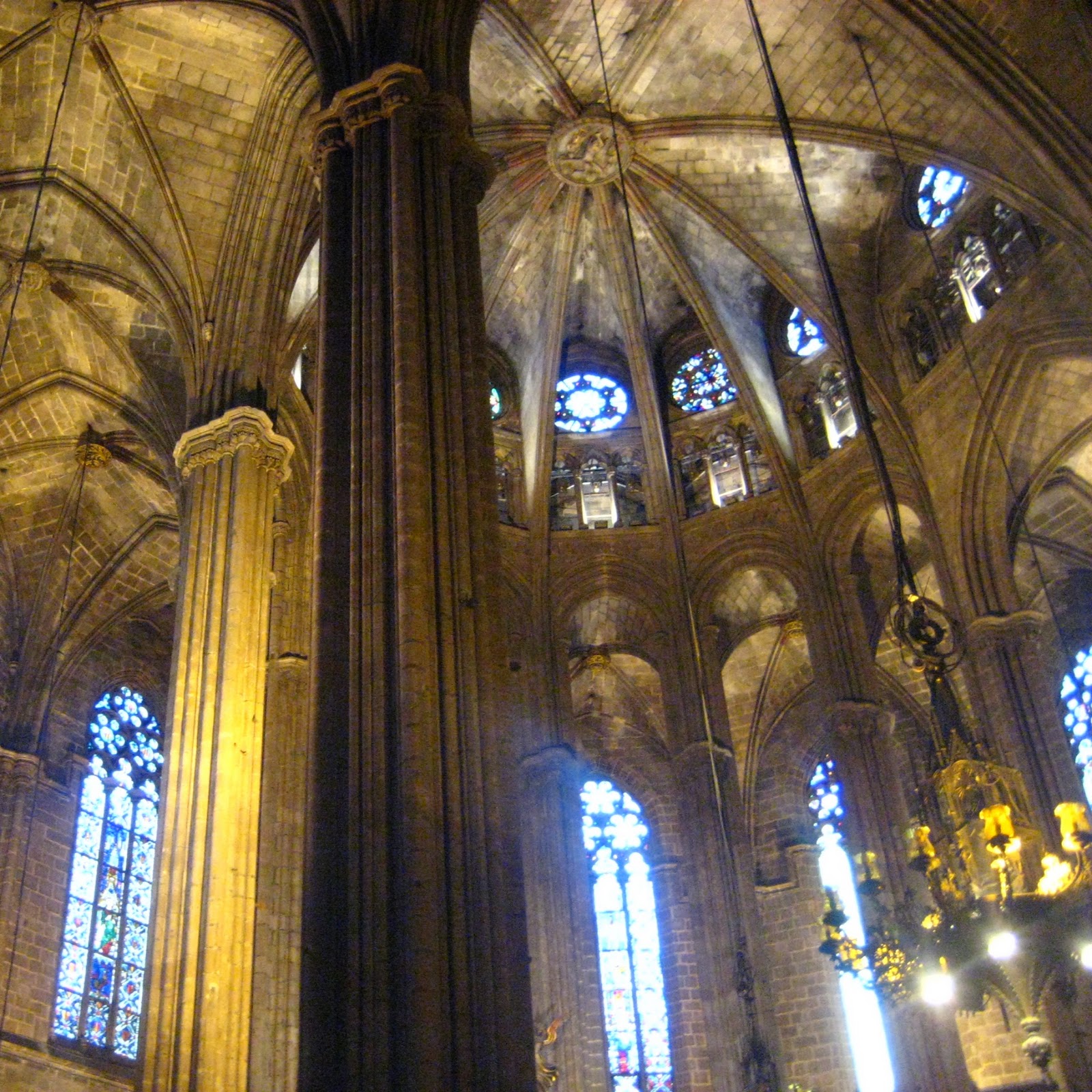 |
| La Seu Cathedral from the inside. |
 |
| La Boqueria, a large market filled with all kinds of fresh fruit juices, chocolates, fruits, and meats. |
 |
| The beach! Probably a little bit more fun while it was still warm out. |
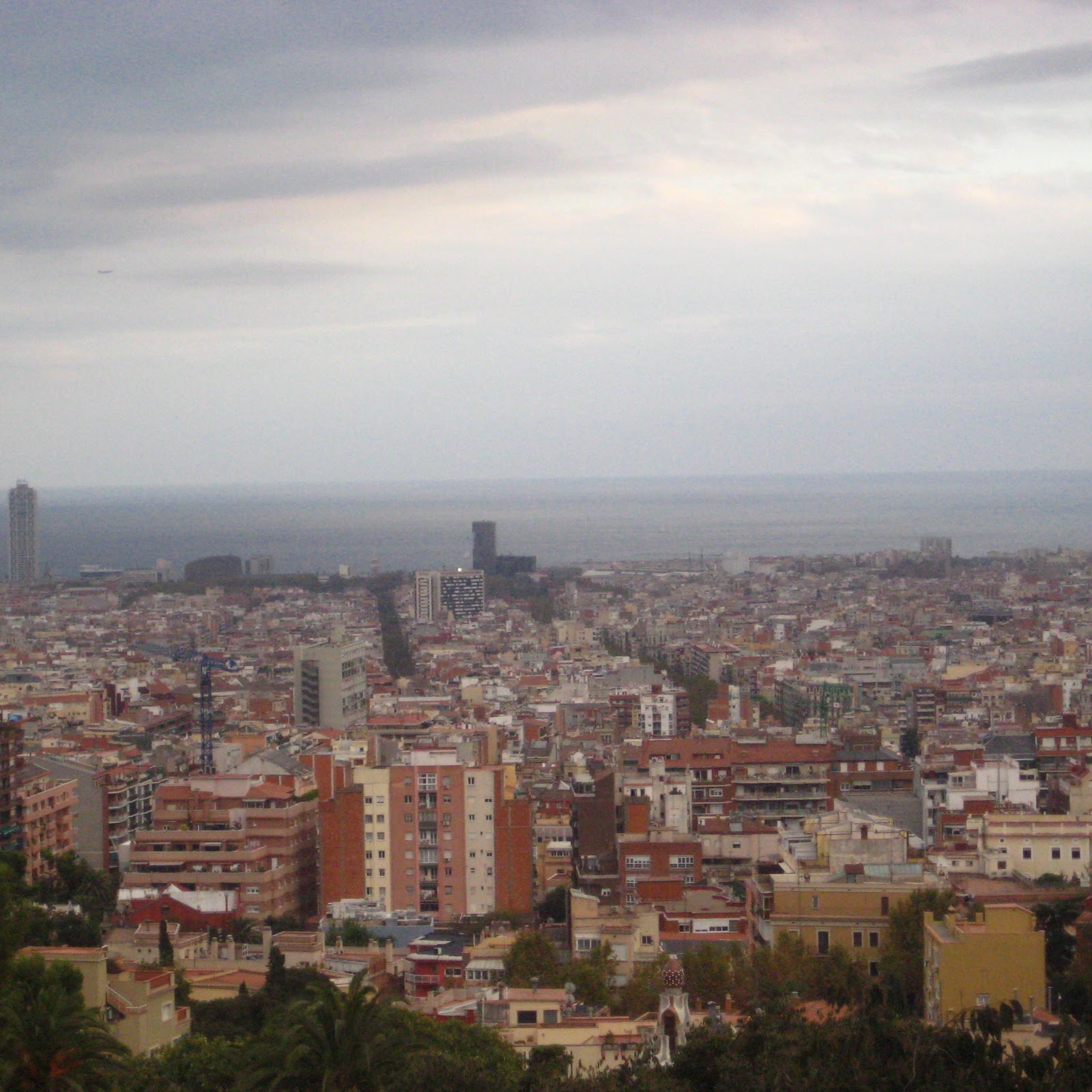 |
| The view from way high up in Park Guell. |
 |
| A beautiful fountain in Ciutadella Park. |
 |
| The Arc de Triomphe |
 |
| The square where they do the castell, the human towers. |
 |
| The Arenas Shopping Center |
 |
| The "Magic Fountain," which dances to pop music and changes color. I love the silhouettes in front of it. |
The second day I fell in love with Gaudi. I had no idea how many of the important buildings in Barcelona he designed. [Gaudi loved architecture, religion, nature, and Catalonia. He led the Modernism movement around Barcelona, and nature as an inspiration is very obvious in his architecture. He was interested in all kinds of crafts including ironwork, ceramics, carpentry, and stained glass, all of which are evident in his designs. He was influenced by the Gothic Revival and died in 1926, during the Arts and Crafts Movement.] Here are some that we saw:


These are from Park Guell. The entrance has two gingerbread looking buildings that you can see in the first picture. The roof line is very organic which is typical of Gaudi. All three pictures have the broken ceramic or mosaic look. The mosaic lizard is probably one of the most famous icons of Barcelona.

This is Casa Batllo (hiding behind a tree), originally built as a house that's now rented out as apartment buildings. It's supposed to look like a bone structure on the bottom with skull-esque balconies, but you can't really see those in the picture.


Across the street from Casa Batllo is La Pedrera, another Gaudi apartment building. Here you can see the building, again with it's organic, nature-inspired waves, the structures on the roof below that, the view from the roof on the right, and the view out a window of one of the apartments. The roof is like a double-figure-eight, with stairs going up and down and all around the pathways. There are arches inside these spiral structures, which are covered in mosaic decorations. Inside the apartment there are Gaudi-designed wooden chairs, iron floral balconies, and Art Nouveau furniture and decorations.
And, of course, Sagrada Familia:


Below on the left is part of the facade, which has geometric, stylized sculptures on it. And next to that is the ceiling, which feels like a canopy.
I have to give some photo credits to Caitlin because my camera died.

Thursday, October 20, 2011
Oh, Mamma Mia!
Last night I went to see Mamma Mia! (in Italian!) The theater was much more modern than I was expecting. The show was really fun, even if I didn't know what they were saying most of the time. Apparently "money money money" and "dancing queen" don't translate to Italian, because they kept those phrases in English.
It was the best when they turned it into an ABBA dance party after the final bows. Does this always happen at Italian musicals? Sign me up for more.
Today the city flooded. The metros were closed for a period of time, and not all the busses were running. I got to walk to school in this. And then I got to take a really hard mid-term in soaking wet jeans. Wet like I just jumped in a pool. Wet like my chair had a puddle on it when I got up after two hours. Also, the exam was terrible. I'm the only person in the class. Thanks, prof.
But now I have ten days off school, and I think they'll be the best ten days of my Roman life! Tonight I'm off to Barcelona.
It was the best when they turned it into an ABBA dance party after the final bows. Does this always happen at Italian musicals? Sign me up for more.
Today the city flooded. The metros were closed for a period of time, and not all the busses were running. I got to walk to school in this. And then I got to take a really hard mid-term in soaking wet jeans. Wet like I just jumped in a pool. Wet like my chair had a puddle on it when I got up after two hours. Also, the exam was terrible. I'm the only person in the class. Thanks, prof.
But now I have ten days off school, and I think they'll be the best ten days of my Roman life! Tonight I'm off to Barcelona.
Subscribe to:
Posts (Atom)